


Chancellor John Healey faces serious challenges in funding Burnham’s grand aspirations Search analysis, research,
academics… Home Arts + Culture Economy Education Environment + Energy Ethics + Religion Health Politics + Society
Science + Tech World Podcasts Local En Español Edition Africa Australia Brasil Canada Canada (français) Català
España Europe France Global Indonesia New Zealand United Kingdom United States Donate Skip to content Edition: United
States Africa Australia Brasil Canada Canada (français) Català España Europe France Global Indonesia New Zealand
United Kingdom s Donate Newsletters Academic rigor, journalistic flair Arts + Culture Economy Education Environment +
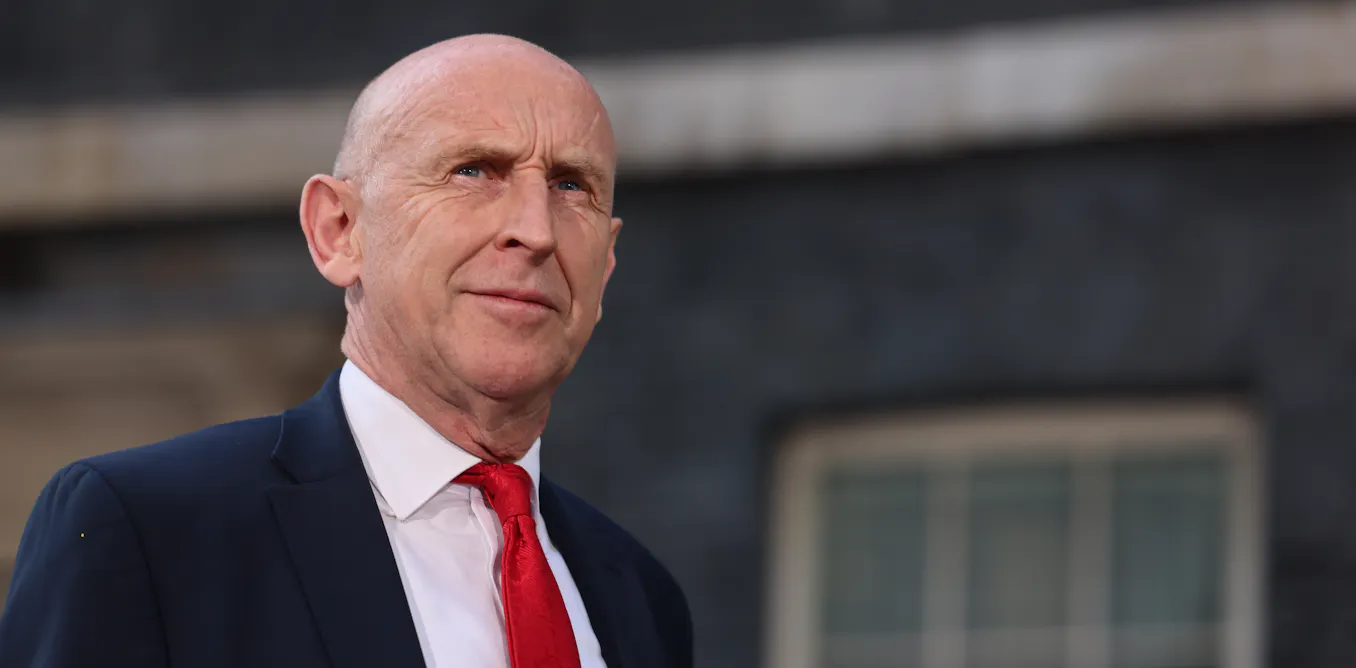
Energy Ethics + Religion Health Politics + Society Science + Tech World Podcasts Local EPA/ANDY RAIN Chancellor John
Healey faces serious challenges in funding Burnham’s grand aspirations Published: July 22, 2026 2:51am EDT
https://theconversation.com/chancellor-john-healey-faces-serious-challenges-in-funding-burnhams-grand-aspirations-288005
https://theconversation.com/chancellor-john-healey-faces-serious-challenges-in-funding-burnhams-grand-aspirations-288005
Link copied Share article Share article Copy link Email Bluesky Facebook WhatsApp Messenger LinkedIn X (Twitter) Print
article The UK’s new prime minister, Andy Burnham, laid out a radical agenda in his short speech upon taking office.
He called for a long-term strategy to reverse 40 years of Thatcherism, and the privatisation and centralisation that
resulted. Wisely, he put a ten-year horizon on these objectives and it is now up to his new chancellor, John Healey, to
realise his ambitions. Sensibly, Burnham has also announced less costly but limited measures to deal with the cost of
living and the housing crisis – intended to convince the public that he understands their concerns. So far these
include a pledge to cap single bus fares in England at £2, cut VAT on electricity bills from October, and end rough
sleeping (with no time frame specified). The government said that the cut in energy bills is fully funded by scrapping
plans for digital IDs. But spending watchdog the Office for Budget Responsibility (OBR) has pointed out that the funding
for this was set to be covered by further, albeit modest, cuts to other government departments. Read more: John Healey
is the UK’s chancellor: what Burnham’s surprise pick says about his style of government By appointing Healey,
Burnham has reassured the bond markets, which feared the more leftwing Ed Miliband would become chancellor. Healey
resigned as defence secretary in June, which played a major role in Keir Starmer’s resignation. His exit was caused by
the Treasury refusing to find the funds to allow the UK to reach Nato’s defence spending target of 3% of GDP. Now it
will be Healey’s job to find this money. Other long-term goals will be just as expensive. Building council housing,
fixing social care and acquiring privatised companies will all make a considerable dent in the government’s finances.
These have already been weakened by the effects of the Iran war, with growth this year projected to be just 1%. Like all
chancellors, Healey’s central aim must be to boost long-term growth and productivity. This is the only way to ensure
prosperity for voters and enough funds to improve public services without increasing government debt. Although Burnham
has pledged to abide by the fiscal rules and Labour’s promise not to raise income tax, VAT or national insurance, the
chancellor will be able to find a number of tweaks that give him room for manoeuvre – just as chancellor, Rachel
Reeves revised the fiscal rules in a way that eased restrictions on borrowing money in order to invest. Many new
policies, from building council housing to funding social care and training for young people, have long-term benefits to
the economy. There could be an argument for reclassifying these as investment spending. In the case of council housing,
it is actually providing the government with a valuable physical asset. Time for a wealth tax? Meanwhile, there are also
many ways to increase revenue without breaking Labour’s taxes pledge. Burnham’s main focus is likely to be further
taxation of wealth, which might aim to equalise rates with taxation on earned income. Tax relief on private pensions,
which mainly benefit the better-off, could also be a target. And changes to the top rate of income tax, if it was
balanced by an increase in the personal allowance to ensure people on the basic state pension do not pay income tax,
could be popular. The most contentious issue will be the taxation of property. Broadly, the reform of council tax –
the system introduced by the Thatcher government and still based on property valuations made more than 30 years ago –
would sharply increase costs in rich areas like London and the south east, while easing burdens further north. But that
would have to be accompanied by a redistribution of funds to northern councils, which would otherwise see their revenues
fall sharply. This points to the broader question facing the Treasury – and the government – on how to carry out a
meaningful devolution to the regions. It is likely to mean giving some of central government’s revenues – such as
income tax – to regional authorities. They could also be given powers, like in Scotland, to raise income tax in their
region. There are also some fixes that could reduce the government’s deficit – the difference between what it brings
in and what it spends. Firstly, key policies such as social care could be funded by a special tax on housing, as Burnham
himself proposed in 2010 when he was health secretary. And some of the huge increase in defence spending might be funded
jointly by a number of Nato countries issuing a common defence bond, which might lower borrowing costs and may not be
counted as part of UK government debt. Finally, the government could gain effective control of failing private
utilities, such as Thames Water, without fully nationalising them. Rates relief for small businesses, including pubs,
could be popular. EPA/ANDY RAIN Like all chancellors, Healey will have to balance the need for more spending with
voters’ desire for lower taxes. It will take a clever politician to square this circle, given the weakness of the UK
economy and that of its key trading partners. One route to achieving these objectives without upsetting the markets is
to put forward measures that show it is on the side of the people, while announcing revenue-raising measures aimed at
more unpopular targets. For example, a cut in rates for small businesses (especially pubs) in northern cities could be
popular, and might be funded by higher taxation of warehouses owned by retail giants. Devolution could also help by
pushing responsibility to the local level. Voters would then be able to see the benefits in their own communities. And
giving councils a bigger role in welfare reform may pay off if investment in training and mental health support led to a
national reduction in the welfare bill. This will be one of Healey’s key objectives, as well as being a major concern
for the markets and the OBR. So far the markets have adopted a “wait and see” approach to the Burnham government.
The autumn budget could be crucial in determining whether the new administration has a credible long-term economic
strategy that can win both public support and market acceptance. UK economy UK government Andy Burnham Steve Schifferes,
City St George's, University of London Author Steve Schifferes Honorary Research Fellow, City Political Economy
Research Centre, City St George's, University of London Disclosure statement Steve Schifferes does not work for,
consult, own shares in or receive funding from any company or organization that would benefit from this article, and has
disclosed no relevant affiliations beyond their academic appointment. Partners City St George's, University of
London provides funding as a founding partner of The Conversation UK. View all partners DOI
https://doi.org/10.64628/AB.ddf6fjgap Want to write? Write an article and join a growing community of more than 230,000
academics and researchers from 5,568 institutions. Register now Editorial Policies Community standards Republishing
guidelines Friends of The Conversation Analytics Our feeds Donate Get newsletter Who we are Our charter Our team
Partners and funders Resource for media Work for us En Español Contact us
Privacy policy Terms and conditions Corrections Copyright © 2010–2026, The Conversation US,
Inc.