


How North Korea Stole 1,000 Volvos From Sweden All That's Interesting history | curiosities | archaeology | news | Today
In History Members Podcast Newsletter Search Facebook Email How North Korea Stole 1,000 Volvos From Sweden By Braden
Bjella | Edited By John KuroskiPublished July 22, 2026 In 1974, North Korea ordered 1,000 Volvo sedans from Sweden —
but to this day, the cars have not been paid for. With interest accruing for 52 years, North Korea's total debt now sits
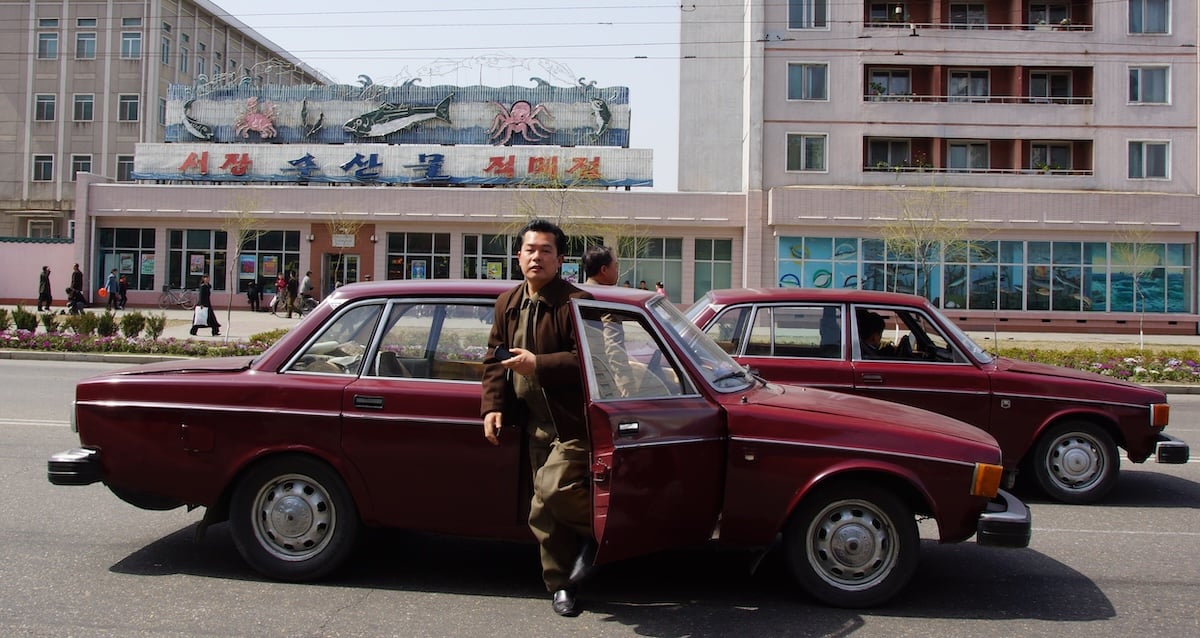
at $342 million.gadgetdan/FlickrSeveral of the stolen Volvos pictured in Pyongyang. In 1974, North Korea ordered 1,000
Volvo sedans from Sweden. They still have not paid for them. Given how closed off the country is from much of the world,
stories about North Korea are often filled with half-truths and unverifiable information. However, there’s one
story that’s been well-documented — and it’s about how North Korea ordered 1,000 Volvos from Sweden, never
paid for them, and, in the process, inadvertently and surprisingly helped build a useful relationship between the two
nations. But how did this even happen in the first place? North Korea Orders 1,000 Volvos From Sweden While many now
think of North Korea as an impoverished, internationally isolated state, it was not always seen that way. In fact, in
the 1950s and ’60s, many considered the North Korean economy to be stronger than that of their South Korean
neighbors, as it had rebuilt much of its industrial base after the Korean War with Soviet and Chinese support. North
Korea wanted to use this economic strength to further industrialize. To that end, the country developed a plan to
purchase and import Western technology on credit, increase its own domestic production, then repay the loans with the
resulting output and export earnings. Generally speaking, this was not seen as a bad idea. In fact, a declassified U.S.
intelligence assessment of North Korea’s Six-Year Plan for 1971-1976 was surprisingly optimistic. While it noted
that debt repayment could become an issue in the late 1970s, it speculated that, given the country’s industrial
growth, North Korea would likely be able to service its new debts with relative ease. Seeing an opportunity to enter a
largely untapped market, Sweden began setting up diplomatic relations with the country, becoming one of the first
Western nations to do so. For its part, North Korea was eager to work with Sweden in order to make progress toward its
own industrialization goals. Roman Harak/Wikimedia CommonsThese Volvo 144 GL four-door sedans were used in North Korea
for decades, with some still spotted in recent years. Consequently, in 1974, the country ordered equipment and other
goods worth approximately 600 million Swedish kronor (or about $73 million) from its new Scandinavian partners. This
order included items from several Swedish companies: Atlas Copco, ASEA, Kockums, Alfa Laval — and, notably, Volvo,
from which the country ordered 1,000 144 GL four-door sedans. North Korea’s Economy Hits A Rough Patch By the time
the order arrived, however, things were starting to take a turn for North Korea. The 1973 oil crisis had raised energy
and production costs. At the same time, prices for some of North Korea’s raw material exports declined, and the
country’s manufactured goods were struggling to find a foothold in international markets. While the imported
Western technology was meant to help curb these issues, this too was causing problems. Some of the technology could not
be used, either because it was unnecessary given current production levels or because it simply could not be operated in
the conditions available within the country. To make matters worse, the debts for all of these imports needed to be
repaid in hard currency — something that North Korea had trouble earning without adequate exports. As a result, the
country began defaulting on many of its debts, effectively closing it out of international financial markets. One of
these defaulted debts was to the government-run Swedish Export Credit Agency, known as EKN. This was the agency that
insured sales from Volvo and other companies to North Korea. Once the country began defaulting, it effectively acquired
a growing sovereign debt to the Swedish state. Wikimedia CommonsOne of the Volvos stolen from Sweden sits in Pyongyang
in 2012. As the Swedish state was, effectively, the guarantor of the sales, the companies involved were able to receive
payments. Instead, the weight of the debt was absorbed by the EKN — and it began doing everything it could to collect
on it. Sweden Attempts To Collect Payment For The Volvo Sedans — To This Day After the sale, Sweden continued
deepening its ties with North Korea, even as the country began defaulting on its debts. In 1975, Sweden became the first
Western country to set up an embassy in Pyongyang. Now inside the country, this diplomatic mission made a significant
effort to investigate North Korea’s finances and try to recover some of its money. Jakob Steinrücken/Wikimedia
CommonsThe Embassy of Sweden in Pyongyang, North Korea. Eventually, Sweden began sending North Korea a bill twice a year
showing the remaining debt and increasing interest. The current debt is estimated to be at around 3.3 billion kronor as
of 2026, equivalent to around $342 million USD. While North Korea made some small payments on this debt until the 1980s,
no significant contribution has been made in decades. But what happened to the cars? Because there have long been
relatively few privately operated vehicles in North Korea, Volvo 144 GL four-door sedans were easily and quickly spotted
on the country’s roads. They were typically used as official transport vehicles, taxis, or vehicles for foreign
visitors. Available evidence suggests that these cars were used for decades and that there were at least a few examples
still in use in 2025, though Volvo states that maintaining these vehicles was likely difficult due to the lack of
available parts. Given the recent growth of the North Korean car market, however, it’s likely that these cars are
no longer needed. While many focus on the stolen Volvos aspect of this story, perhaps a more interesting aspect is how,
paradoxically, this debt helped strengthen the relationship between Sweden and North Korea — and created a valuable
asset in the country for many Western nations. By having an embassy in the country, Sweden effectively became a Western
intermediary between North Korea and nations without embassies in Pyongyang, such as the United States. This has allowed
citizens of many Western countries to receive embassy-related services in the country. Whether North Korea will ever
repay this debt in full is unknown. Until it does, what remains of those 1,000 Volvos will be monuments to one of
history’s strangest international deals gone awry. For more bizarre stories from North Korea, learn about Room 39
— the country’s mysterious state-run slush fund. Then, browse through the strange web pages of the North Korean
internet. Share Flipboard Email Our Editorial Standards All That's Interesting is a U.S.-based digital publisher that
employs subject-level experts to produce our articles. Each article is written by a staff member or a highly-vetted
freelancer, and is reviewed by at least one editor. For licensing and permission inquiries, visit Wright's Media. Become
a member to help support our work and enjoy our site ad-free. author author Braden Bjella Braden Bjella is a culture
writer. His work can be found in the Daily Dot, Mixmag, Electronic Beats, Schon! magazine, and more. editor editor John
Kuroski Based in Brooklyn, New York, John Kuroski is the editorial director of All That's Interesting. He graduated from
New York University with a degree in history, earning a place in the Phi Alpha Theta honor society for history students.
An editor at All That's Interesting since 2015, his areas of expertise include modern American history and the ancient
Near East. In an editing career spanning 17 years, he previously served as managing editor of Elmore Magazine in New
York City for seven years. Citation copied COPY Cite This Article Bjella, Braden. "How North Korea Stole 1,000 Volvos
From Sweden." AllThatsInteresting.com, July 22, 2026, https://allthatsinteresting.com/north-korea-volvos. Accessed July
23, 2026. Sign Up For The ATI Newsletter Sign Up Previous Post Inside Centralia, The Pennsylvania Ghost Town That's Been
On Fire Since 1962 Next Post Archaeologists Unearthed 3,700-Year-Old Daggers And Arrows Suggesting That Ancient Egyptian
Princesses Were Skilled With Deadly Weapons You might also like 100 Interesting Facts About The World Trending on ATI
What Stephen Hawking Thinks Threatens Humankind The Most Trending on ATI 27 Raw Images Of When Punk Ruled New York
Trending on ATI About Contact Editorial Standards Jobs Privacy Policy PO Box 24091 Brooklyn, NY 11202-4091