


How sugarcane is powering Indonesia's bioethanol ambition - ANTARA News Bahasa Indonesia Latest News Popular News
Top News Antara Photo Home Current IssueWorldBusiness & InvestmentExplore IndonesiaArticlePhotoPress Release ×
Home Home version one Home version two Home version three Home version four Pages Blog Style 1 Style 2 Style 3 Submenu
item 3 Multi level 1 Multi level 2 Submenu item 4 Submenu item 5 Blog single detail Style 1 Style 2 Style 3 Search
Result Style 1 Style 2 Login Register Contact 404 Error About Style 1 Style 2 Category contact © 2020 Home Article How
sugarcane is powering Indonesia's bioethanol ambition News Feature How sugarcane is powering Indonesia's bioethanol
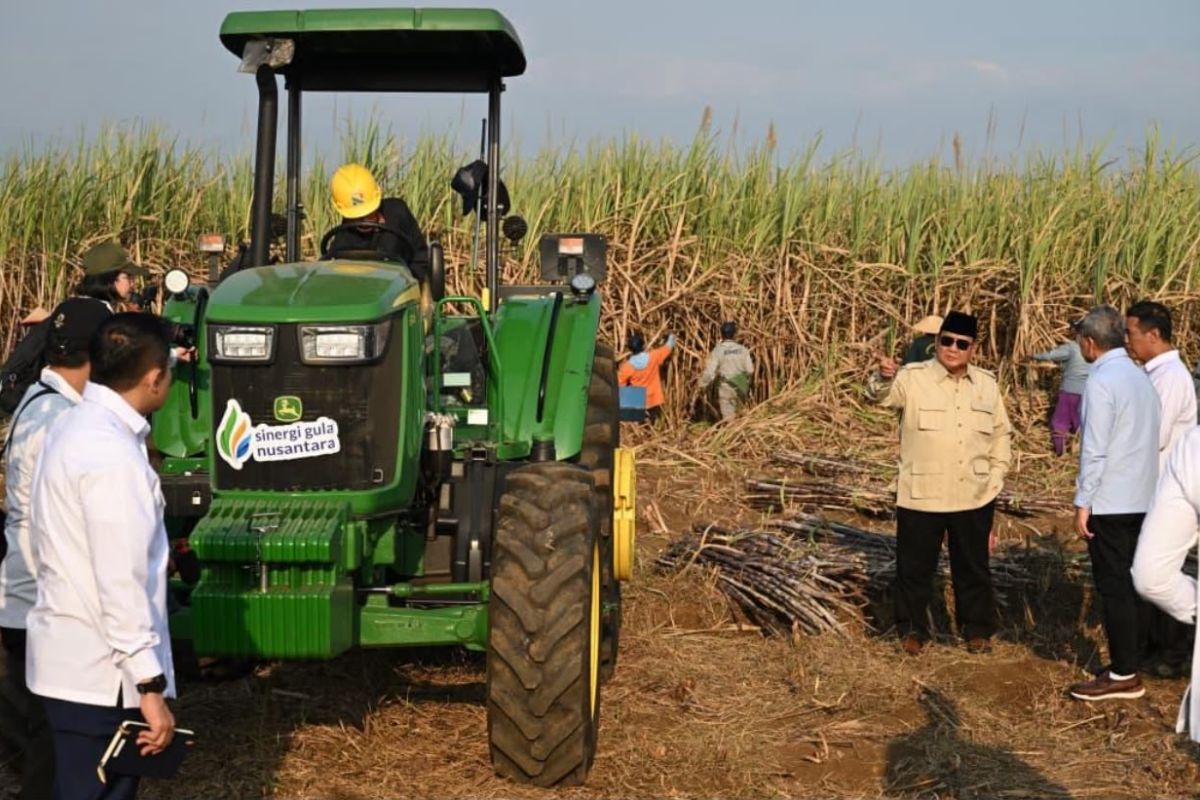
ambition July 22, 2026 18:56 GMT+700 President Prabowo Subianto attended a simultaneous nationwide sugarcane harvest in
Malang District, East Java, on Sunday (July 17, 2026). (ANTARA/HO-PT SGN) ..these targets will only materialize if
factories are truly constructed, the molasses supply chain remains resilient, and crop prices stay fair for the
farmers..Jakarta (ANTARA) - Landing at Abdulrachman Saleh Airport in Malang, passengers are greeted by sprawling green
fields that look like wild grass from above but are actually vast stretches of sugarcane. As it turns out, those
sugarcane plantations are more than just a scenic backdrop surrounding the air base. The sugarcane is actively
cultivated for production and is destined for more than just sweetening coffee or tea. Beyond meeting the nation's
sugar needs, it is helping power Indonesia's transition to bioethanol. During a visit to the sugarcane plantation
near the air base on Friday, July 17, President Prabowo Subianto sounded the siren to mark the start of a nationwide
harvest at 43 locations. The initiative kicked off harvesting for three key commodities, including sugarcane, rice, and
soybeans. Of the three commodities, sugarcane accounts for the largest share. Land managed under the Indonesian Air
Force's food security program spans 236,048 hectares, with the potential to produce 18.386 million tons of
sugarcane, equivalent to 1.36 million tons of sugar, or 45.05 percent of this year's national sugar production
target. At Abdulrachman Saleh Air Force Base alone, 800.5 hectares are ready for harvest, with an estimated yield of
72,045 tons of sugarcane. Viewed through the lens of Indonesia's history, the expansion to 236,048 hectares reveals
a striking irony. In the 1930s, the Dutch East Indies produced up to 3 million tons of sugar annually on roughly 196
thousand to 200 thousand hectares in Java, yielding an impressive 14.7 tons of sugar per hectare from far less land.
Sugar exports reached 2.4 million tons, making the Dutch East Indies the world's second-largest sugar exporter after
Cuba. In other words, the land now managed by the Indonesian Air Force under its food security program already exceeds
the total sugarcane plantation area in Java during the colonial government's most productive period, although
projected sugar output has yet to match that historical record. The difference between then and now is not only about
sugar yield rates and milling technology but also about the direction of the commodity itself. During the colonial era,
sugar flowed overseas, filling the coffers of the Dutch East Indies government and supplying European markets, while
local sugarcane farmers remained at the end of the value chain with the smallest share of the benefits. Following
independence, the national sugar industry fell into a long decline, accelerated by the impact of World War II.
Consequently, Indonesia transformed from one of the world's premier sugar exporters into one of its largest
importers for decades. For this reason, the simultaneous harvest in Malang represents a crucial step toward reversing
that historical trajectory, redirecting sugar production to secure domestic needs first. Related news: Indonesia targets
E10 bioethanol fuel rollout by 2027 Bioethanol What sets today's effort apart from history is the fate of the
sugarcane itself. Abdulrachman Saleh Air Force Base is evolving into an integrated hub, managing the crop from field to
final product. Rather than focusing solely on commercial sugar, the facility converts processing byproducts like
molasses into bioethanol, organic fertilizers, and an array of high-value industrial materials. During the harvest
event, officials from Pertamina New and Renewable Energy presented to the President a comparison of bioethanol
implementation in India, where the blending rate has reached 20 percent (E20), and Brazil, which has implemented a
mandatory E30 blend, with E100 already in use in several states. In response, the President directed officials to
establish 50 new bioethanol plants, stressing that Indonesia must rapidly close the gap with these global leaders. The
government, through the Ministry of Energy and Mineral Resources, has gradually begun implementing a five-percent
bioethanol blend (E5) since July 2026 in six provinces, namely East Java, Jakarta, West Java, Banten, Central Java, and
Yogyakarta. Although the current roadmap targets E10 implementation between 2028 and 2030, Energy and Mineral Resources
Minister Bahlil Lahadalia is preparing to jump directly to mandatory E20 implementation to begin in 2028. The bioethanol
market index price as of July 2026 has been set at Rp10,933 per liter, calculated using a formula that directly links
the price of farmers' molasses to the value of the biofuel. Bioethanol demand to achieve E20 is estimated at eight
million kiloliters, a figure that appears large but is relatively small compared with annual gasoline imports, which
stand at around 20 million kiloliters annually. Molasses, once a by-product of sugar processing, has now become a raw
material for substituting imported fuel, and every hectare of harvested sugarcane carries dual value, serving as a
source of both table sugar and domestic energy. The upstream-to-downstream model also changes the economic incentives
for sugarcane farmers because demand, which once depended entirely on sugar prices, is now also supported by molasses
prices linked to national energy needs. Building 50 new processing plants, expanding the E5 rollout across six
provinces, and reaching E20 by 2028 is a bold national ambition. Yet these targets will only materialize if factories
are truly constructed, the molasses supply chain remains resilient, and crop prices stay fair for the farmers tending
the fields. Related news: B50, E5 drive Indonesia toward energy self-sufficiency Related news: Prabowo targets up to 50
ethanol plants to support E20 fuel program Related news: Prabowo reviews sugar-to-bioethanol project to boost energy
securityEditor: M Razi Rahman Copyright © ANTARA 2026 sugarcanesugar industrybioethanolenergy securityfood security
Related News RI eyes sugar sufficiency with accelerated sugarcane rejuvenation push 20th July 2026 Food security
requires legal certainty over land rights : Minister 18th July 2026 Indonesia targets two-year sugarcane rejuvenation
under Prabowo 17th July 2026 Prabowo targets full sugar self-sufficiency with two-year overhaul 17th July 2026 Prabowo
reviews sugar-to-bioethanol project to boost energy security 17th July 2026 Deputy minister taps cooperatives to boost
sugarcane farmers' welfare 15th July 2026 Indonesia taps village cooperatives to boost sugar industry growth 15th July
2026 RI eyes 5.9 billion sugarcane buds in 2026 to drive sugar sufficiency 12th March 2026 Indonesia targets 3 million
tons of sugar output by 2026 27th December 2025 Minister pushes 70,000-hectare sugarcane expansion in East Java 23rd
December 2025 Pertamina draws inspiration from Brazil’s ethanol success at COP30 12th November 2025 Indonesia maps out
920,000 ha of land for ethanol production push 12th November 2025 Latest News Indonesia to issue Panda Bonds to reduce
US dollar reliance 1 hour ago Indonesia urges China to expand investment in AI, high-tech 1 hour ago Indonesia pitches
US$1.8 billion data center sector to Chinese firms 2 hours ago Danantara acquires four asset managers with US$10.5 bln
AUM 3 hours ago Indonesia, South Korea seek stronger digital Halal trade 3 hours ago Popular News Indonesia unveils plan
for world-class international financial hub 21st July 2026 Indonesia begins first Russian oil imports under
150-mln-barrel plan yesterday 20:04 Indonesia advances 93 hydrogen projects worth US$2 billion yesterday 05:32 Indonesia
aims to attract high end tourist through Bali marina project 21st July 2026 Strengthening Indonesia's role in global AI
governance 21st July 2026 Kertajati Airport MRO hub targeted to begin operations in 2026 22 hours ago Indonesia urges
ASEAN to deliver tangible benefits, stability 21st July 2026 Indonesia eyes becoming Asia's hydrogen hub yesterday 16:24
Indonesia fast-tracks permits for dairy farm investors 20th July 2026 Indonesia plans 40,000 fish farms to boost protein
self-sufficiency 21st July 2026 Top News FM Sugiono highlights community resilience at ASEAN-Russia PMC 1 hour ago
Indonesia pitches US$1.8 billion data center sector to Chinese firms 2 hours ago Indonesia buys 12 Italian Leonardo
M-346F Block 20 jets 2 hours ago Bali blocks foreign investment in 18 business categories 3 hours ago Prabowo, FBI's
Patel discuss return of smuggled Indonesian artifacts 6 hours ago Indonesia calls for stronger ASEAN-US cooperation as
stability anchor 9 hours ago Indonesia, China prioritize key projects under Twin Parks scheme 11 hours ago Indonesia
eyes becoming Asia's hydrogen hub yesterday 16:24 Indonesia targets 151,554 hectares for coconut downstreaming in 2026
yesterday 15:15 Indonesia moves to strengthen defense ties with Turkiye, Malaysia yesterday 14:49 Latest News Top News
Popular News Current IssueWorldBusiness & InvestmentExplore IndonesiaArticlePhotoPress Release Bahasa Indonesia Term of
Use Privacy Policy Cookie Policy About Us Cyber Media Guidelines RSS Copyright © ANTARA