


Ukraine peace, Europe’s militarization, Iran war and nuclear proliferation: Lavrov’s ASEAN briefing — RT Russia &
Former Soviet Union icon bookmark-bicon bookmarkicon cameraicon checkicon chevron downicon chevron lefticon chevron
righticon chevron upicon closeicon v-compressicon downloadicon editicon v-expandicon fbicon fileicon filtericon flag
ruicon full chevron downicon full chevron lefticon full chevron righticon full chevron upicon gpicon insicon mailicon
moveicon-musicicon mutedicon nomutedicon okicon v-pauseicon v-playicon searchicon shareicon sign inicon sign upicon
stepbackicon stepforicon swipe downicon tagicon tagsicon tgicon trashicon twicon vkicon yticon wticon fm
العربيةESPРУСDEFRRS Where to watch Schedule RT News App Question more AI-powered Russian drones strike
Ukrainian shipping (MOD VIDEOS) | Russia-Ukraine Conflict live Russia & Former Soviet Union World News Business India
Africa RT Features Analysis Opinion Entertainment Shows Projects AI-powered Russian drones strike Ukrainian shipping
(MOD VIDEOS) | Russia-Ukraine Conflict HomeRussia & FSU Ukraine peace, Europe’s militarization, Iran war and nuclear
proliferation: Lavrov’s ASEAN briefing Russia’s foreign minister discussed US-backed Ukraine peace efforts, Western
participation in the conflict, and the wider fallout from the war in the Middle East Published 22 Jul, 2026 17:20 |
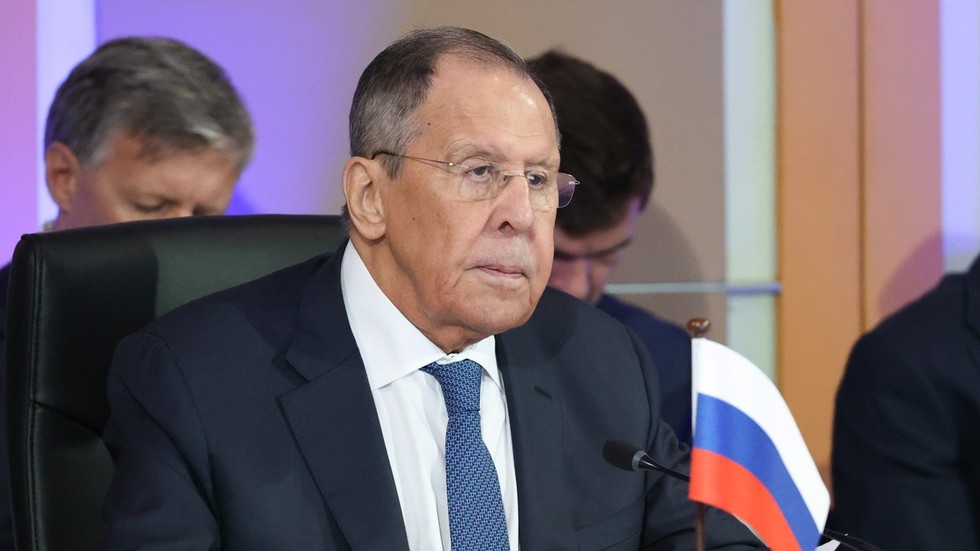
Updated 22 Jul, 2026 18:25Russian Foreign Minister Sergey Lavrov. © Sputnik / Russian Ministry of Foreign Affairs
Russian Foreign Minister Sergey Lavrov addressed the Ukraine conflict, tensions with the US and Europe, the war on Iran,
nuclear proliferation, and security in Asia at a press conference following meetings of the Association of Southeast
Asian Nations (ASEAN) on Wednesday.He also outlined plans to expand Russia’s economic and political cooperation
with the Southeast Asian bloc.Here are the key takeaways: READ MORE: FBI chief plans Moscow trip – Politico Ukraine
and the Anchorage understandingsMoscow continues to believe that Washington has not abandoned the understandings reached
by Russian President Vladimir Putin and US President Donald Trump in Anchorage last year, Lavrov said.According to him,
the talks produced agreement on key issues of a possible settlement, with both sides favoring a lasting peace deal over
a temporary ceasefire in Ukraine. Russia therefore still regards the proposals discussed there as a basis for further
negotiations.Lavrov said he would seek clarification on Washington’s current position during his meeting with US
Secretary of State Marco Rubio on Thursday.He also stated that most ASEAN countries understand Russia’s position
that the Ukraine conflict can only be resolved by addressing its root causes.US role in Ukrainian strikes on
RussiaLavrov denounced what he called US hypocrisy, saying Washington had falsely claimed that Russia and China were
supplying Iran with weapons for retaliatory strikes on American military facilities while itself playing a direct role
in Ukrainian attacks on Russian territory. READ MORE: US directly involved in Ukrainian strikes on Russia – Lavrov The
foreign minister said the allegations came amid the broader US-Israeli war on Iran and contrasted them with what he
described as Washington’s extensive military support for Kiev.“The Americans, through arms supplies paid for
by the European Union, the provision of intelligence, the Starlink system and much more, are not simply helping, but are
directly participating in guiding Ukrainian weapons toward targets, including civilian targets, on Russian
territory,” he said.Europe’s militarizationThe EU is prioritizing rearmament over its
citizens’ social and economic needs, Lavrov claimed, adding that Moscow takes Europe’s growing
militarization seriously and is adjusting its own planning accordingly.He also warned that if European countries once
again united “under the familiar banners” and sought to attack Russia, “it will no longer be a
conventional war.” READ MORE: Renewed US-Iran strikes: Is a major war looming? Moscow opposes those wanting to
prolong US-Iran warHostilities between the US and Iran are in neither country’s interest and it is difficult to
predict when the conflict would end, Lavrov said.He noted Washington’s repeated declarations to have resolved the
crisis and reopened the Strait of Hormuz, only for the waterway to close again. Conflicting interpretations of the
US-Iran memorandum, Israel’s insistence that it was not bound by the agreement, and Trump’s subsequent
declaration that the document had been canceled altogether have only added more uncertainty, he added.Lavrov mentioned
unnamed parties encouraging both sides to prolong the fighting, but stressed that Russia was “not among
them,” insisting that Moscow wants the conflict to end due to its impact on the global economy.He also rejected
suggestions that Moscow should welcome oil prices rising above $90 per barrel, adding that Russia prefers stable energy
prices that allow it to make long-term economic plans. New nuclear risks after war on Iran, Iraq, and
LibyaThe US-Israeli attack on Iran could persuade more countries that nuclear weapons are the only reliable guarantee of
sovereignty. Before the war, the International Atomic Energy Agency had found no evidence that Iran was diverting its
civilian nuclear program for military purposes, Lavrov pointed out, before comparing Iran’s fate to that of Iraq
and Libya, which abandoned their weapons programs but were still attacked by Western powers.“The effect is the
opposite of what was probably expected from the attack on Iran,” Lavrov said, arguing that more states could now
conclude that “only nuclear weapons” can guarantee their freedom and independence. READ MORE: The nukes
stay: China and North Korea are building something bigger Reports from Russian intelligence suggesting Germany could be
developing its own nuclear weapons were a source of serious concern, Lavrov emphasized.Asian alternatives – a
nuclear North KoreaRussia no longer supports calls to denuclearize the Korean Peninsula, Lavrov announced. Given
increased US-led military exercises and intensifying military activity in the region, it is clear that North Korea sees
no alternative to nuclear weapons for safeguarding its sovereignty.Moscow fully supports Pyongyang’s efforts to
strengthen its defensive capabilities and understands its position, Lavrov declared.Debates in Japan over revising the
country’s non-nuclear principles are a “serious signal,” he said, linking it to the expanding nuclear
component of US-South Korean military exercises. READ MORE: Russia and ASEAN should deepen cooperation amid US sanctions
– Indonesian professor ASEAN, Asia, finance and tradeWestern countries have exploited their centuries-long dominant
position in global finance and trade through sanctions, tariffs, and other restrictions, Lavrov said. In response,
Russia and its partners are expanding settlements in national currencies and discussing alternative financial platforms
that would be less vulnerable to outside pressure, he said.He warned that exclusive US-backed security groupings in the
Indo-Pacific are trying to undermine ASEAN’s central role in the region and replacing its consensus-based approach
with bloc politics aimed largely at containing China and sidelining Russia.Russia and ASEAN members broadly share a
commitment to a multipolar international system based on equality, mutual benefit, and respect for national sovereignty,
Lavrov stressed.The minister highlighted plans to deepen practical cooperation between Russia and ASEAN, noting that
trade had reached around $22 billion last year, and that the two sides intend to double that figure by 2036 through
closer ties in technology, energy, space, maritime cooperation, food security, counterterrorism, and humanitarian
exchanges.Recap You can share this story on social media: Follow RT onAssociation of Southeast Asian Nations –
ASEANEuropeIranNuclear weaponsRussiaSergey LavrovUSUkraineNorth Korea Please check our commenting policy. If you have
questions or suggestions feel free to send them to feedback@rttv.ru. Show comments You use your browser with disabled
JavaScript. Please enable JavaScript for comments.More