


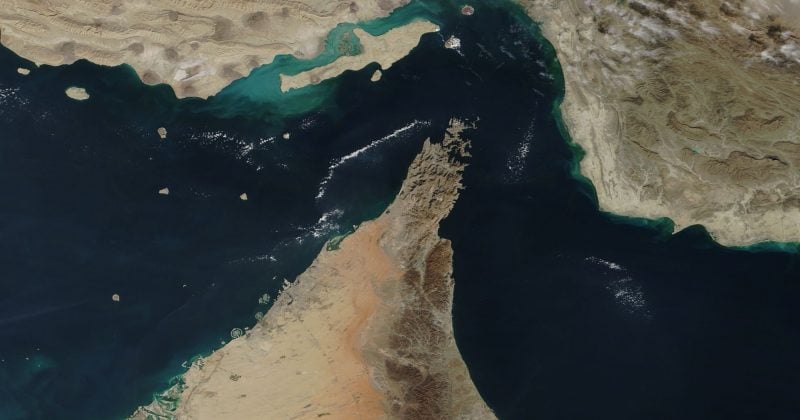
US and Iran negotiate Strait of Hormuz ceasefire with crypto toll twist English Español Crypto Markets Prediction
Markets Macro AI Tech Research Sports Newsletter Podcasts Advertising Try Vera Sections Bitcoin DeFi Ethereum NFTs AI
Agents Regulation Web3 Business Ecosystem Sections Soccer Esports Crypto Bitcoin DeFi Ethereum NFTs AI Agents Regulation
Web3 Business Ecosystem Markets Prediction Markets Macro AI Tech Research Sports Soccer Esports Newsletter Podcasts
Advertising Try Vera SEARCH Searching... US and Iran negotiate Strait of Hormuz ceasefire with crypto toll twist Iran
wants to charge oil tankers $1 per barrel to transit the strait, payable in Bitcoin or stablecoins Share Add us on
Google by Editorial Team Jul. 26, 2026 The United States and Iran are deep in negotiations over an interim ceasefire
that would reshape how commercial vessels transit the Strait of Hormuz, one of the most strategically important
chokepoints on the planet. The twist that should catch every crypto investor’s attention: Iran has proposed
collecting transit tolls in Bitcoin and stablecoins. The strait handles roughly 20% of global oil shipments. When it
gets disrupted, oil prices spike, supply chains scramble, and risk assets, including crypto, start behaving erratically.
What’s on the table A June 2026 memorandum of understanding attempted to extend a fragile truce originally
established on April 8, with the goal of reopening the strait for commercial shipping. Under the terms being discussed,
Iran would gain more significant management input over vessel transit through the passage, essentially giving Tehran a
formal role in controlling traffic through waters it has long claimed strategic authority over. Iran’s headline
proposal is a toll of $1 per barrel for oil-laden tankers passing through the strait. That number sounds modest until
you consider the volume. With millions of barrels transiting daily, even a dollar-per-barrel fee adds up to serious
revenue. Advertisement Iran doesn’t want that revenue in dollars. The proposed payment mechanism calls for Bitcoin
or stablecoins, processed quickly to help Tehran generate income while sidestepping the sanctions regime that has choked
its access to traditional financial rails for years. Oman has been playing mediator in the discussions, pushing for Iran
to publicly commit to maintaining open shipping lanes and refraining from attacks on commercial vessels. The ceasefire
that wasn’t President Trump declared in mid-July 2026 that the June ceasefire was effectively “over”
following new clashes in the region. He simultaneously called for continued discussions. The April ceasefire lasted
weeks before tensions flared again. The June memorandum was supposed to provide more durable footing, but the cycle
repeated. Every escalation pushes oil prices higher, with disruptions during the ongoing tensions driving prices above
$100-$108 per barrel at various points. Why crypto traders should care The obvious angle here is Iran’s push to
collect sovereign-level tolls in cryptocurrency. If implemented, this would represent one of the most significant
real-world use cases for crypto in international commerce to date. Iran has been cut off from SWIFT and most
dollar-denominated trade for years. Crypto offers a workaround, and Washington knows it. Any deal that formalizes
crypto-denominated tolls would put US negotiators in the awkward position of implicitly endorsing a sanctions bypass
mechanism while trying to secure shipping lane stability. From a pure trading perspective, the correlation between oil
price spikes and Bitcoin volatility has been notable throughout this conflict cycle. Recent dips in Bitcoin’s
price have coincided with escalations in the Strait of Hormuz situation. Bitcoin has also seen buying interest during
peak uncertainty, suggesting some market participants view it as a hedge. Oil price movements above $100 per barrel have
historically triggered immediate reactions in Bitcoin trading volumes. Monitoring political developments around the
negotiations, particularly any formal agreement on crypto-denominated tolls, could provide leading indicators for both
markets. Disclosure: This article was edited by Editorial Team. For more information on how we create and review
content, see our Editorial Policy. POLITICS US and Iran negotiate Strait of Hormuz ceasefire with crypto toll twist Iran
wants to charge oil tankers $1 per barrel to transit the strait, payable in Bitcoin or stablecoins by Editorial Team
Jul. 26, 2026 Share Add us on Google The United States and Iran are deep in negotiations over an interim ceasefire that
would reshape how commercial vessels transit the Strait of Hormuz, one of the most strategically important chokepoints
on the planet. The twist that should catch every crypto investor’s attention: Iran has proposed collecting transit
tolls in Bitcoin and stablecoins. The strait handles roughly 20% of global oil shipments. When it gets disrupted, oil
prices spike, supply chains scramble, and risk assets, including crypto, start behaving erratically. What’s on the
table A June 2026 memorandum of understanding attempted to extend a fragile truce originally established on April 8,
with the goal of reopening the strait for commercial shipping. Under the terms being discussed, Iran would gain more
significant management input over vessel transit through the passage, essentially giving Tehran a formal role in
controlling traffic through waters it has long claimed strategic authority over. Iran’s headline proposal is a
toll of $1 per barrel for oil-laden tankers passing through the strait. That number sounds modest until you consider the
volume. With millions of barrels transiting daily, even a dollar-per-barrel fee adds up to serious revenue.
Advertisement Iran doesn’t want that revenue in dollars. The proposed payment mechanism calls for Bitcoin or
stablecoins, processed quickly to help Tehran generate income while sidestepping the sanctions regime that has choked
its access to traditional financial rails for years. Oman has been playing mediator in the discussions, pushing for Iran
to publicly commit to maintaining open shipping lanes and refraining from attacks on commercial vessels. The ceasefire
that wasn’t President Trump declared in mid-July 2026 that the June ceasefire was effectively “over”
following new clashes in the region. He simultaneously called for continued discussions. The April ceasefire lasted
weeks before tensions flared again. The June memorandum was supposed to provide more durable footing, but the cycle
repeated. Every escalation pushes oil prices higher, with disruptions during the ongoing tensions driving prices above
$100-$108 per barrel at various points. Why crypto traders should care The obvious angle here is Iran’s push to
collect sovereign-level tolls in cryptocurrency. If implemented, this would represent one of the most significant
real-world use cases for crypto in international commerce to date. Iran has been cut off from SWIFT and most
dollar-denominated trade for years. Crypto offers a workaround, and Washington knows it. Any deal that formalizes
crypto-denominated tolls would put US negotiators in the awkward position of implicitly endorsing a sanctions bypass
mechanism while trying to secure shipping lane stability. From a pure trading perspective, the correlation between oil
price spikes and Bitcoin volatility has been notable throughout this conflict cycle. Recent dips in Bitcoin’s
price have coincided with escalations in the Strait of Hormuz situation. Bitcoin has also seen buying interest during
peak uncertainty, suggesting some market participants view it as a hedge. Oil price movements above $100 per barrel have
historically triggered immediate reactions in Bitcoin trading volumes. Monitoring political developments around the
negotiations, particularly any formal agreement on crypto-denominated tolls, could provide leading indicators for both
markets. Disclosure: This article was edited by Editorial Team. For more information on how we create and review
content, see our Editorial Policy. Loading more articles... You've reached the end Follow Us Quick Links Bitcoin
Ethereum DeFi Markets NFTs AI Tech AI Agents Newsletter Regulation Podcast Notes Macro Advertising CB Select Company
Team Contact Advertising Account Log In Quick Links Bitcoin Ethereum DeFi Markets NFTs AI Tech AI Agents Newsletter
Regulation Podcast Notes Macro Advertising CB Select Follow Us Account Log In All content is for informational purposes
only and does not constitute investment advice. CryptoBriefing does not provide recommendations to buy, sell, or hold
any asset or contract. See our Disclaimer & Risk Disclosure. © Decentral Media and Crypto Briefing® 2026.
About Us Editorial Policy Disclaimer Privacy Policy RSS Login Sign Up Sign in to your account Forgot Password? Staff
& Editor login (2FA required) Sign In or Continue with Google Create your account CryptoBriefing may send me offers
and promotions. I accept Terms and Conditions / Privacy Policy Create account or Continue with Google Already have an
account? Sign In Forgot your password? Please enter your email address. You will receive a link to create a new password
via email. Email Reset Link Sign In Get Crypto Briefing in your inbox Daily news, analysis & market insights
delivered free. Subscribe ×