


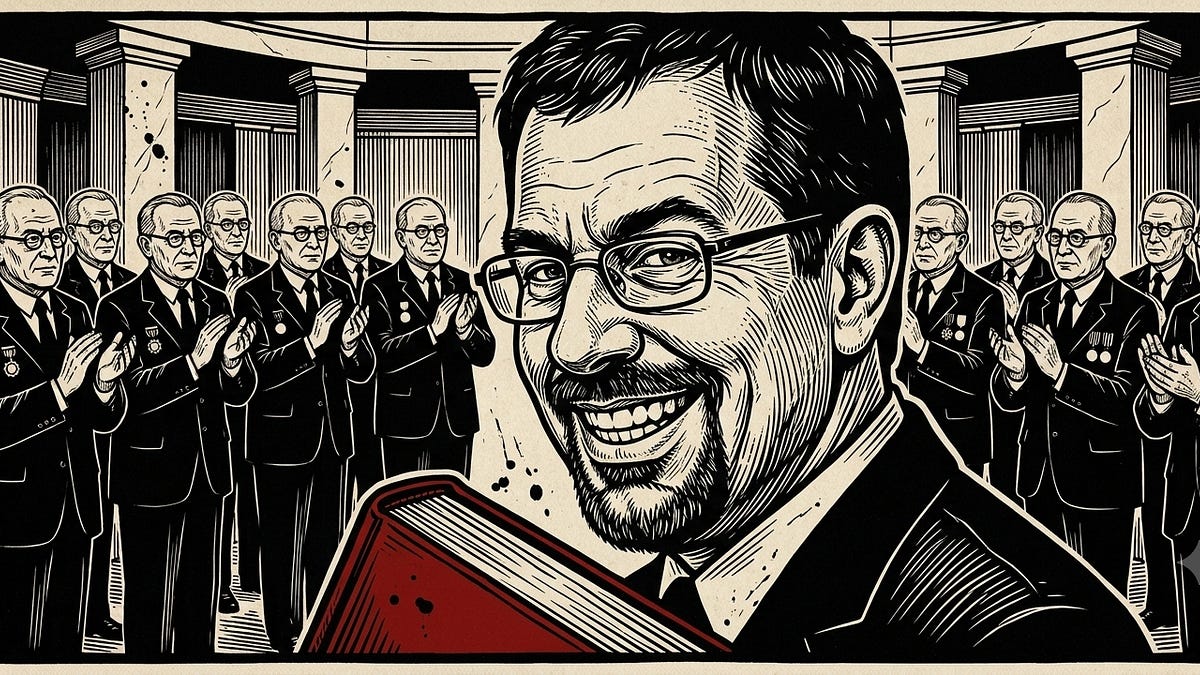
Working-Class Liberalism: Anatomy of an Oxymoron SubscribeSign inWorking-Class Liberalism: Anatomy of an OxymoronDaron
Acemoglu’s new book is hitting the shelves. The author is the recipient of the 2024 Nobel Prize in Economics. A glance
at the book's endorsers gives a good idea of its content.Özcan BuzeAug 08, 20269ShareThe Confession on the Back
CoverDon’t read the book first. Read the back cover. Blurbs are not advertising for a book; they are its class
credentials. To learn whom a work addresses, you needn’t consult the table of contents. The guarantors will tell
you.Daron Acemoglu’s new book, What Happened to Liberal Democracy?, is reaching the shelves — in Turkish, Hangi
Liberal Demokrasi, which is to say Which Liberal Democracy. The author is an Institute Professor at MIT, the best-known
advocate of the thesis that institutions determine development, and a Nobel laureate in economics for 2024. Now to the
guarantors.Thomas Piketty is there: the man who openly confessed he never managed to get through Marx’s Capital, then
sat down and wrote the Capital of the twenty-first century. Steven Pinker is there: the Harvard professor who calls his
own liberalism the Enlightenment and imperialist capitalism civilization, and has made a career of proving by statistics
that this civilization keeps improving — the same Harvard professor who in 2007 supplied Jeffrey Epstein’s defense
team with a linguistic opinion on the “plain meaning” of the federal statute prohibiting the use of the internet to
entice minors into sexual abuse. Jared Diamond is there: the popular anthropologist who explains European domination of
the world by germs, cereal species and the axes of continents, converting colonialism into a geographic accident and
selling his Western reader both knowledge and absolution in one volume; the same anthropologist who named two living men
in Papua New Guinea, accused them of dozens of killings, drew a libel suit and forced his magazine to concede that its
fact-checking had collapsed. His blurb, listing the questions the book answers, poses this one without blinking: how can
ignorant people be made useful? The sentence gives itself away.Michael Sandel is there: the moral philosopher who
indicts the tyranny of merit without touching property once. Esther Duflo is there: the development economist who
reduces poverty to randomized controlled trials, measures the effect of distributing bed nets, and never asks who owns
the land. Joel Mokyr is there: the economic historian who explains the Industrial Revolution by a culture of useful
knowledge rather than by the slave trade and colonial plunder. Angus Deaton is there: the laureate who counted the
deaths of despair among American workers and later admitted his profession had been wrong about unions and about
power.James Robinson is there: co-author of Why Nations Fail, which is to say the other half of the institutional theory
the book rests on, saluting his own paradigm as a major paradigm shift. Simon Johnson is there: former chief economist
of the International Monetary Fund — the institution that administered structural adjustment across the global South
for half a century — now vouching for a book on shared prosperity.Steven Levitt is there, author of Freakonomics, the
man who turned economics into a parlor trick.Ro Khanna is there: the congressman representing Silicon Valley’s
district, author of Progressive Capitalism.The publisher is Dutton, which is Penguin Random House. Four hundred sixteen
pages, thirty-two dollars, August 11, 2026. The Turkish edition is introduced by Asaf Savaş Akat, a leading liberal
figure of the current that traveled from the Workers’ Party of Turkey to the New Democracy Movement and to what is
known there as second-republicanism.Nobel laureate, we are told. An Oscar tells you as much about the worth of a film as
a Nobel tells you about work in science, in literature or in peace. And the prize given in economics is not even a
Nobel. Alfred Nobel’s will of 1895 contains no economics; that prize was established in 1968 for the tercentenary of
the Swedish central bank, funded by the bank, with the Nobel name borrowed. A prize founded and financed by a central
bank should not be expected to reward an economics hostile to central banking as it exists under capitalism. Nor did it:
Friedrich August Hayek in 1974, Milton Friedman in 1976 — the latter the head of the school that supplied the economic
program of the Pinochet dictatorship in Chile.The fortune that lent the prize its name is no obscure matter either.
Alfred Nobel invented dynamite and ballistite and bought the Swedish firm Bofors to turn it into an arms works; his
customers were armies. His brothers Ludvig and Robert sat atop the oil of Baku and built Branobel into the largest
company in the Russian empire — and the labor regime in those fields produced the strikes of 1903 and 1905, the
strikes that made Baku one of the centers of the revolutionary movement. A prize endowed by gunpowder and petroleum
should not be expected to reach those who question the order of gunpowder and petroleum.Now read the book’s thesis:
liberalism was a philosophy built to challenge power, and it never fully adjusted to becoming the establishment
itself.The back cover refutes the thesis. A book launched with the joint applause of the Western academy, four
laureates, the International Monetary Fund and the largest publishing conglomerate on earth informs us that liberalism
remained a stranger to the establishment. History has seen few strangers so well accommodated.These names did not
assemble by chance. They lecture from the same chairs, meet in the same foundation salons, blurb one another’s books
and award one another prizes. The book that says liberalism never adjusted to the establishment is being introduced to
us by the establishment. It sounds like a joke. It isn’t.Liberalism Was Not Born Against PowerAcemoglu’s founding
premise is historically false. Liberalism was not born as a philosophy against power. It was born as a philosophy of
power.Take John Locke, since he is the founding name of the liberal canon. Locke served as secretary to the Lords
Proprietors of Carolina. He held shares in the Royal African Company, the chartered monopoly that trafficked slaves. He
had a hand in drafting the Fundamental Constitutions of Carolina of 1669, whose relevant article reads: every freeman of
Carolina shall have absolute power and authority over his negro slaves. His theory of property is the justification of
enclosure and of land seizure in the Americas: land deemed unimproved belongs to the man who mixes his labor with it. At
first hearing it sounds right. But ask who decided which land counted as unimproved, and the whole secret of liberalism
opens up. To ask the Native Americans, the actual owners of that land, could never have crossed the liberal mind.The
Glorious Revolution of 1688 was not an opposition movement. It was the constitutional partnership agreement of a new
ruling bloc — landed aristocracy joined to commercial bourgeoisie. Liberalism is the philosophy of that agreement.John
Stuart Mill is taken to be the summit of liberal thought. He spent thirty-five years as a functionary of the East India
Company. In On Liberty he writes: despotism is a legitimate mode of government in dealing with barbarians, provided the
end be their improvement. The most luminous text of liberalism translates the administrative logic of an empire into
philosophy.In France, François Guizot answered the demand to widen the franchise with a single word: enrichissez-vous.
Enrich yourselves. The property qualification was not a deviation from liberalism but its program. Liberals fought
democracy for a century. The hyphen in “liberal-democracy” is the record of a war they lost.Whatever democratic
content the thing called liberal democracy now possesses was not liberalism’s gift. It was wrested from liberalism by
the Chartists, the unions, the socialists, the women’s movement, the revolts in the colonies. Acemoglu credits the
donor for what was taken from him.The Enlightenment Is Something ElseIf what is meant is the struggle against feudal
aristocracy, then calling that struggle liberalism is wrong too. It was the Enlightenment; it was the fight for the
rights of man; it belonged to the historical moment when the bourgeoisie was genuinely revolutionary.Marx and Engels
gave that moment more than its due. The Communist Manifesto records that the bourgeoisie tore men from their feudal
dependencies, developed the productive forces beyond the sum of all preceding generations, and put an end to the idiocy
of rural life. The praise is sincere. It concerns the historical function of a revolutionary class.That function,
though, is historical, which is to say bounded. The year 1789 is both the dawn and the ceiling of the same class. The
Enlightenment’s claim to universality halts the moment it strikes the property interest of the class carrying it. The
rights of man were proclaimed while the slave plantations of Saint-Domingue — today’s Haiti — went on working;
Toussaint Louverture, who took the proclamation seriously, died in a French prison.To identify liberalism with the
Enlightenment is to stretch a class’s revolutionary youth across its entire life. Pinker’s decision to title a book
Enlightenment Now is the plainest document of that appropriation. Acemoglu’s narrative performs the same operation: it
presents one morning of the bourgeoisie at the barricade as the moral record of a two-hundred-year order.Whose
Freedom?The entire vocabulary of liberalism rests on a single word: freedom. Open that word and the whole doctrine opens
with it.Marx is sardonic when he describes the sphere of circulation in the first volume of Capital. The market where
labor power is bought and sold is a very Eden of the innate rights of man: Freedom, Equality, Property and Bentham. The
name at the end of the list is a joke. Jeremy Bentham was the English thinker who held that every human act could be
reduced to a calculus of utility; by setting him beside the principles, Marx tells us the fourth pillar of bourgeois
ideals is self-interest. Each looks only to himself, and the common good is supposed to arise from the spontaneous
harmony of these selfishnesses. The parties are free, because no one compels anyone. They are equal, because they meet
as owners of commodities. The contract is signed by consent. Then Marx takes us out of that noisy sphere and down into
the hidden abode of production, where the money-owner strides ahead as capitalist and the owner of labor power follows
as his worker — one smirking, the other watching his own hide being carried to market.The worker’s freedom is
double. He is free to dispose of his labor power as his own commodity. He is also free of the means of production, which
is to say deprived of them. The second freedom is the name given to dispossession. The peasant torn from the land by
enclosure acquired exactly one liberty: the liberty to starve.Seen from here, the class weight of every liberal freedom
becomes measurable. Freedom of the press is the freedom of whoever owns a press — today, of the media monopolies.
Freedom of contract is the freedom of the party able to dictate terms. The right of property is the right of those who
have property. The law, in its majestic impartiality, forbids rich and poor alike to sleep under bridges.Today the
asymmetry stands before us entirely unconcealed. The free movement of capital is guaranteed by international treaty; a
fund manager moves billions across continents at a keystroke and no one asks him for a visa. The movement of labor is a
crime. The same legal order grants capital unlimited passage and grants human beings the floor of the Mediterranean. No
document exposes the class content of liberalism’s concept of freedom more nakedly.Acemoglu’s proposal of a
working-class liberalism does not touch this asymmetry at any point. Shared prosperity, empowered local communities, the
coexistence of differing values — all of it speaks the language of the sphere of circulation. The hidden abode of
production is never entered. And so long as it is not entered, the freedom on offer remains the freedom not of the man
with nothing to sell but his labor power, but of the man who buys it.1848: The Year the Unadjusted Philosophy
AdjustedThe claim that liberalism never adjusted to becoming the establishment has a date on which it can be tested.
June 1848.In February the French bourgeoisie overthrew the monarchy alongside the workers. Four months later it turned
the artillery on the workers of Paris. Thousands dead, tens of thousands deported. Liberalism adjusted to the
establishment that week. It did not require a generation. Four months sufficed.The crushing of the Commune in 1871
repeats the lesson. The liberal republic preferred an understanding with Prussia to an understanding with its own
workers. Liberalism after 1848 is no longer the interrogation of the order but its rational administration. In Marx’s
phrase, the bourgeoisie replaced scientific economics with hired prizefighters.Acemoglu is not ignorant of this history.
To assume he is would be unfair to him. The trouble is that his thesis is built so as not to be able to carry it.Where
Do Institutions Come From?A single methodological decision unites Acemoglu’s entire body of work: institutions are the
independent variable.Why Nations Fail (2012, with James Robinson) erects the dichotomy of inclusive and extractive
institutions. Wealth arises from inclusive institutions, and institutions are inclusive because they generate wealth —
the circle feeds itself. Colonialism is reduced in this scheme to a problem of institutional transplantation: bad
institutions where settlers died, good institutions where they survived. The place of the slave trade in capital
accumulation, the deliberate destruction of Indian textile manufacture, the opium wars — all become entries in a
statistic of geographic accident. What Britain was abroad is never asked of the Britain that was inclusive at home.The
Narrow Corridor (2019) applies the same method to politics. Between state and “society” there runs a corridor of
balance, and classes are invisible inside it. The moment society is treated as a single actor, exploiter and exploited
go into one sack.Power and Progress (2023, with Simon Johnson) argues that the direction of technology is not a natural
necessity but a product of power relations. This is half a step in the direction of materialism. Half, because the
question is always framed as who will steer, never as who will own.The measure itself is a decision. Pinker’s
statistical apparatus for demonstrating the decline of violence confines violence to homicide rates and battlefield
deaths; debt bondage, famine, children dead in mines, the balance sheet of structural adjustment enter no column.
Whoever draws the ruler determines the reading. Acemoglu’s ruler of institutions works the same way.The new book
continues this line. The sentence “liberal democratic institutions plunged themselves into crisis” is meaningful
only if institutions are the first cause. See institutions as the forms in which class relations crystallize and the
sentence collapses. The crisis is not a malfunction of the institutions; it is their function. A determinate phase of
capital accumulation — monopoly, financialization, deindustrialization — produces its own political shell. That the
shell is called democracy does not make the shell democratic. That the 2024 prize went precisely to this
colonial-institutions work is itself instructive: the prize certifies not a discovery but a paradigm.The Roosevelt
LegendPiketty’s blurb states the book’s program in one line: the rebuilding of a Roosevelt-style working-class
liberalism.President Roosevelt’s New Deal was not a philosophy realizing itself. It was the concession American
capital made to save itself in the face of the crash of 1929, millions unemployed, the sit-down strikes, the militant
unionism organized by the CIO, a substantial communist party, and a Soviet Union executing its five-year plans at the
opposite pole. What extracts a concession is pressure, not generosity.Not one component of that pressure is still
standing. Union density sits at a historic floor. The Soviet Union is gone. The mass of industrial workers was dispersed
and production relocated. To lift a settlement out of the balance of forces that made it possible and present it as a
reconstructible model is to reduce history to a recipe. Wanting Roosevelt while not wanting the class struggle that made
Roosevelt possible — this is the formula of the entire social-democratic daydream.One more thing bears recalling: the
New Deal passed by compromising with Jim Crow. Agricultural and domestic workers, the great majority of them of African
descent, were written out of social security because the votes of Southern senators were required. What drew the
boundary of inclusion was not philosophy but the arithmetic of a class alliance.The Credentialed Elite: Stratification
in Place of ExploitationA sentence is missing from the Turkish promotional copy — the sentence carrying the book’s
real thesis. In the English original it runs: as a segment of college-educated elites became politically dominant and
separated from the rest of society, they sowed the seeds of widespread inequality while intensifying efforts to reshape
mass culture and values.That is the heart of the book. The Turkish blurb skipped it.The operation is this. The
contradiction is lifted out from between those who own the means of production and those compelled to sell their labor
power, and set down between those with diplomas and those without. Cultural stratification takes the place of
exploitation. The question of who appropriates whose surplus labor becomes the question of who looks down on whom.The
thesis is not new. Piketty’s Brahmin left, David Goodhart’s anywheres, Michael Lind’s new class war, Michael
Sandel’s tyranny of merit — all belong to one family. The ground they share with right-populism’s anti-elite
narrative is startlingly wide. What they have in common is the ability to construct an account of inequality without
laying a finger on property relations. If the billionaire of Silicon Valley and the research assistant at a provincial
university fall into the same category of credentialed elite, that category explains nothing.The introduction to the
Turkish edition domesticates the logic: a productive model of cooperation and solidarity between responsible
intellectuals and working sections of society. The hierarchy sits in the grammar of the sentence — the intellectual
thinks, the sections work. What follows, a reference to developing countries such as Turkey whose institutional
development suffers from weaknesses, is modernization theory in its purest form. The source of backwardness is located
not in a position within the imperialist division of labor but in a defect of native institutions. Imperialism vanishes
from the sentence entirely. Once dependency is renamed weakness, the remedy naturally becomes better governance.Alms or
Property?Esther Duflo’s blurb gathers the whole program into a single verb: to induce the tech oligarchs to develop
these tools in ways that empower workers. Sandel’s does the same: to equip workers to flourish in the age of
AI.Induce. Equip. Steer. Not one of these verbs alters ownership.The distinction Marx draws in the machinery chapter of
Capital marks the boundary here with precision. Machinery in itself lightens labor. In the capitalist’s hands it
lengthens the working day, intensifies labor, turns the worker into an appendage of the machine and swells the reserve
army. Every leap in the productive forces returns to the laborer as unemployment and intensified exploitation for as
long as the means of production remain private property. Artificial intelligence is not an interruption of this logic
but its most developed moment.The very concept of the labor share conceals this. To measure what percentage of national
income goes to wages is an operation in distribution; it renders invisible how surplus value is produced. Adopt the
measure and you have adopted the question.Marx closed this argument in the Critique of the Gotha Programme: the
distribution of the means of consumption is a secondary phenomenon derived from the distribution of the conditions of
production. Any program that proposes to correct the sharing of consumption goods while leaving the conditions of
production where they stand has surrendered to its own founding assumption. What is set aside for labor is not a right
but an alms, whatever its size.In the phrase “working-class liberalism,” class ceases to be a relation of production
and becomes an adjective pinned to liberalism. Not a historical subject but an electoral bloc to be won. Liberalism is
the political philosophy of the bourgeoisie; attaching the adjective changes nothing in the philosophy and merely widens
its audience.Which Liberal Democracy?The shift in the title was noted at the outset; now for its meaning. The English
original is an inquiry. The fault is placed in time, implying a happy period that later spoiled. The Turkish offers a
menu of options. As though we were to pick a model off the shelf.The answer: none of them.The question is wrongly
framed. What must be asked is not which liberal democracy but whose property. So long as the means of production remain
in private hands, whatever the institutions are called, what holds the reins is that property relation itself. To posit
a supra-class subject capable of steering the direction of technology — the regulatory state, the responsible
intellectual, the deliberative institution — is ideology itself.Four hundred sixteen pages, four laureate guarantors,
the largest publishing conglomerate on earth. This entire apparatus labors so that one sentence will not be spoken. Marx
wrote it a hundred and sixty years ago and it stands where he left it: emancipation lies not in correcting distribution
but in abolishing property.【●】This text was composed from the author’s own ideas, arguments, and source
selection; a large-language-model tool was used during composition for prose editing and visuals. All intellectual and
scholarly responsibility for the content rests with the author.9ShareDiscussion about this
postCommentsRestacksTopLatestDiscussionsNo postsReady for more?Subscribe© 2026 Özcan Buze · Privacy ∙ Terms ∙
Collection notice Start your SubstackGet the appSubstack is the home for great culture This site requires JavaScript to
run correctly. Please turn on JavaScript or unblock scripts